

Whether you are a loner flirting with the idea of starting a business or someone with a team struggling to come up that right business idea this article with get you up and running in less than 3 days.
First thing to realise is to not consider yourself small just because you’re getting started. A small business is never really small because its impact is always huge! One way of making an impact is by developing technology that creates a radical shift in an industry, the silicon valley stuff.
But there’s another and rather exciting way to make a dent into the universe and that is through human innovations. These are generally under looked. These are things such as: supporting a community, satisfying a niche demand, sharing one’s talent and passion with the world and building a business around it, and leveraging technology to combat social issues etc. This is what small business do the best!
All businesses at their core solve a problem or satisfy a definite need. If you solve a problem then you have a business!
Complaints are everywhere we go; from family gatherings to popular culture and media. If you can resolve any one of these you have a business. If you start seeing these complaints as business opportunities you’ll start training your subconscious mind to look at every problem you encounter or hear as an entrepreneurial opportunity and this will change your life. But don’t stop just there, start by exploring solutions. This is what most people never do because they “don’t know how?”.
Today I am going to share a five-step process to turn any problem into a business.
You can achieve this is 3 days, 3 hours or even 3 minutes because sometimes you just need is the framework which will make everything click. But I don’t advise you rush this. It’s okay to take your time on this.
The five steps are:
- Observation
- Problem Discovery
- Ideation
- Business Model
- Revenue
Observation
All things start with observation, start taking notice of problems around you, at home at work, when you hear someone complain and especially when you hear multiple individuals complain about the same thing. What would have happened if Newton didn’t notice the apple that fell down?
Problem Discovery
“If I had asked people what they wanted, they would have said faster horses”.
The above quote is attributed to Henry Ford however its authenticity is under question these days. Whether Henry Ford said this or not there’s a truth in this statement. If you notice someone asking for faster horses it’s not faster horses they are looking after they’re actually looking for faster means of transportation. So there’s a difference between a complaint statement and the actual problem and an entrepreneur must be able to see the difference. Always discover the root cause of any problem.
A simple technique to use is to ask “Why?” five times consecutively. Here is an example:
🥺 Boy, I have a headache…
❓Why? Because I have a cold.
❓Why did you catch a cold? Because yesterday I spent time in the cold.
❓Why? Because I didn’t take my coat.
❓ Why? Because I didn’t think that it would be so cold outside.
❓ Why? Because in the morning I don’t check the weather forecast. (✅)
Solution: Install a thermometer in the balcony and watch it before going out.
Ideation
Ideation is the mode of the design process in which you concentrate on idea generation. Mentally it represents a process of ‘going wide’ in terms of concepts and outcomes. Ideation provides both the fuel and also the source material for building prototypes and getting innovative solutions into the hands of your users. — Stanford d.school
The goal of ideation is to quickly come up with ideas to solve the problem.
Don’t be overly critical in this phase, just sit with your team (or a bunch of friends if you don’t have a team yet) and come up with ideas, engage even your wildest fantasies.
Tips for an effective ideation session:
- Defer judgementEncourage wild ideas
- Build on the ideas of others
- Stay focused on the topic
- One conversation at a time
- Be visual
- Go for quantity
After you have a bunch of ideas put your mind to something else eat a pie, watch a show and come back to it the next day.
The next morning write down any fresh ideas you might have come up with and then remove all the ideas that you think are not commercially viable or technologically feasible?
For example, a supersonic passenger plane is technologically feasible we even had one called Concorde but it wasn’t commercially viable so now we have Airbus 380s.
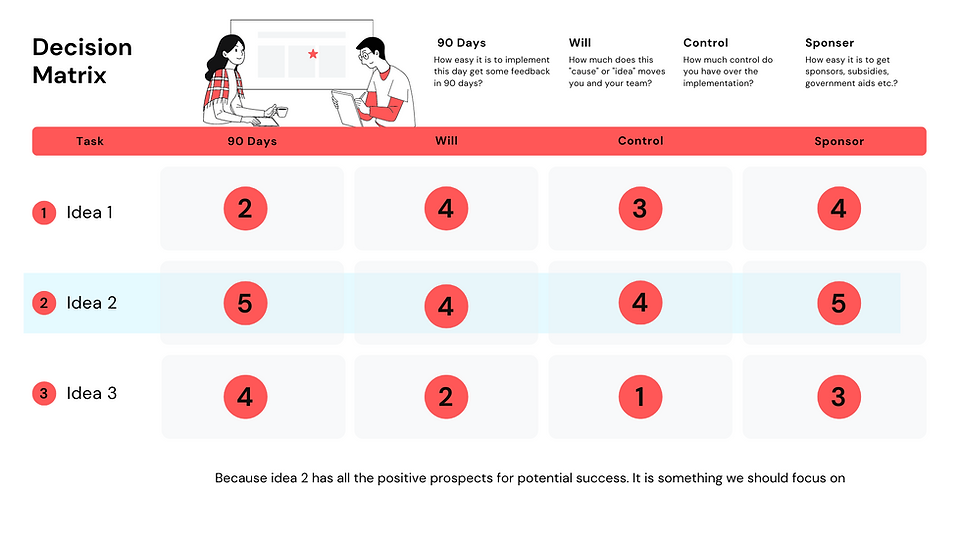
If everything went well you might have 3 to 7 ideas. Now it’s time to test these but how do you prioritise?Make a decision matrix.
My decision matrices usually have these four columns.
• How easy it is to implement this day get some feedback in 90 days?
• How much does this “cause” or “idea” moves you and your team?
• How much control do you have over the implementation?
• How easy it is to get sponsors, grants, investors, subsidies, government aids etc.?
So now you have an idea and resources to implement it but how to monetise it?
Business Model and Revenue
A business model is a company’s core strategy for profitably doing business.
The four most important questions to consider are:
• Who are you selling to?
• What do you sell?
• How do you create and deliver it?
• Why it is commercially viable?
You can even download our TCV Business Trident Canvas (click on the highlighted text to download) to make this process easier.
Now you’re set to go, start sharing about your product/service to your family and friends even while you’re developing it.
Eventually you might want to create a more deliberate marketing strategy but for now, you can even ask some of the people who’s complaints you’re trying to solve, that if we came up with this solution would like to book it in advance for a special pre-launch price.
Talk to people, post on social media and try to earn $1000 dollars in the first three months.
If you succeed with this then take a step back, go back to your drafting table and now put systems in place to scale the business, create a marketing plan and register the business if you haven’t already done so to limit your personal liabilities, consider hiring people, outsourcing tasks etc.
No more juggling and stressing unnecessarily.This is how you do it! When people with money want something (or to get rid of something) more than their money they’ll pay any (fair) price for it. And that is the only sustainable way to be rich by the means of a business. At the end of the day, a business is about revenue and it should be sustainable and profitable.
Thanks for reading? Feel free to ask any questions. I’m always happy to answer! 😁
If you like the article then share it with your family and friends so they can benefit from it too. After all, sharing is caring ;).
P.S. If this process feels a bit complicated then there’s another way to do it. Where you start from your qualifications and skillsets. To learn more refer to TCV’s Raison D’être Canvas.
Leave a Reply
You must be logged in to post a comment.