

Rome wasn’t built in a day, but they were laying bricks every hour. The same is also true for growth in business as in life. Design, whether of a product, service or an entire business, is a highly iterative process.
Design is not linear; it’s not a plan, something you once decide and execute and you are done, it rather evolves through each trial, failure, customer input, ideation, iteration, challenge etc.
In some ways it’s like jazz, you can’t set the design process into stone because it’s all about the live improvisation in response to everything that goes on around it.
Customer demand, market conditions, competition and government policies are constantly changing. And sometimes we may not understand the customer needs and difficulties as clearly as they do. So it’s essential to get that user input in the initial phases of the design.
Instead of waiting for that final reveal after spending a fortune on research and development and hoping everything works out we advise you to test your product in the early stages of design, even if it looks crappy or has the minimum features or amenities. It’s very easy to make changes in the early phases of design and development than in the end.
As a design agency sometimes we even show pencil sketches to our clients and get their feedback, we take notes of a meeting and get feedback so we are not vulnerable to misunderstandings and rework. Getting feedback and making changes in the early phases of design is a lifesaver.

Here is what Guy Kawasaki, an evangelist, author, speaker and one of the original Apple employees responsible for marketing the line of Macintosh computers in 1984 has to say about being crappy:
“The first step in launching a company is not to fire up Word, PowerPoint, or Excel. There’s a time for using these applications, but it’s not now. Instead, your next step is to build a prototype of your product and get it to customers. I call this, “Don’t worry, be crappy”—inspired by Bobby McFerrin’s song “Don’t Worry, Be Happy.”
Another way to use this philosophy is by employing what’s called an MVP, a Minimum Viable Product. A minimum viable product (MVP) is a version of a product with just enough features to be usable by early customers who can then provide feedback for future product development.
Eric Ries, the author of The Lean Startup explains the MVP concept in this way:
“It is not necessarily the smallest product imaginable, though; it is simply the fastest way to get through the Build-Measure-Learn feedback loop with the minimum amount of effort. . . . The goal of the MVP is to begin the process, not end it.”
Mr Kawasaki adds two words to MVP and transforms the acronym to MVVVP: Minimum Viable Valuable Validating Product.
First, the product can be viable—able to get through the feedback loop and make money—but that’s not enough. He says: “It should also be valuable in that it jumps curves, makes meaning and changes the world. Let’s aim high!”
Second, the product should also validate the vision of your startup. Otherwise, you may have a viable and valuable product (which is good) but not necessarily one that validates the big picture of what you’re trying to achieve.
For example, the first iPod was not only a viable product (early to market and profitable); it was also valuable (the first way to legally and conveniently buy music for a handy device) and validating (people wanted elegant consumer devices and Apple could transcend selling only computers and peripherals).
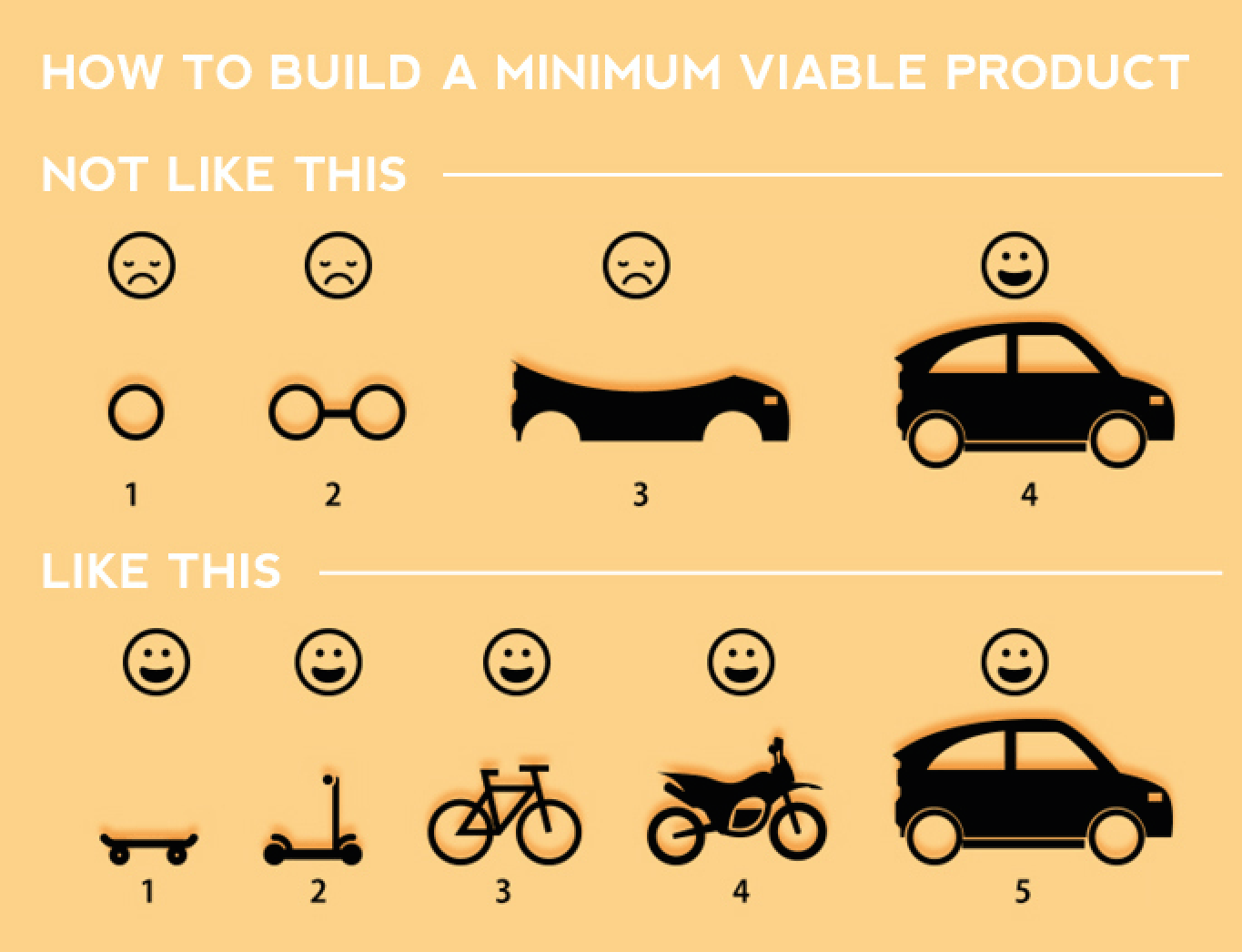
The right way to build an MVP (Source)
Note well that this is not permission to ship a piece of crap but a suggestion for a shift in the mindset i.e. Instead of going all in at once and then regretting or delaying because of the belief in measure twice cut once there’s a third option viz to see each idea as a hypothesis, placing small bets and learning from them, constantly validating and pivoting the business model as necessary. This would lead to the development of a really fluid and progressive organisation.
What are your thoughts on this? Let me know in the comments below. And if you enjoyed this post, share it with your family, friends and fellow entrepreneurs. After all, sharing is caring :).
Leave a Reply
You must be logged in to post a comment.